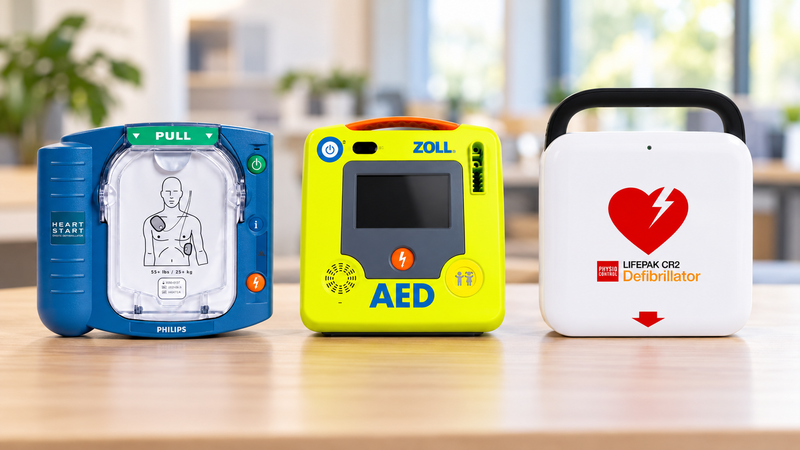
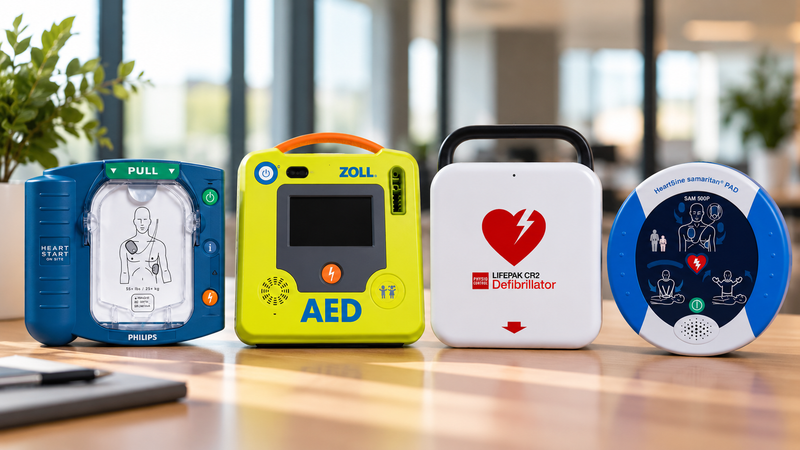
You are shopping for a defibrillator and notice that some models are fully automatic, while others are semi-automatic.
There is no difference in price. The devices look alike, and their features are similar too. So, what really changes?
In fact, the main difference is when the electric shock is delivered. With a semi-automatic defibrillator, the user must press a button. With a fully automatic model, the device delivers the shock itself after warning those present.
In both cases, the defibrillator analyzes the heart rhythm and determines whether a shock is necessary.
So, should you opt for an automatic model to avoid an extra step? Or a semi-automatic one to maintain control over when the shock is delivered?
Let's look at what distinguishes the two devices and what that really means for your business.
How does a semi-automatic defibrillator work?
The semi-automatic defibrillator is probably the type of device you have already seen in an office, store, or sports facility.
When a person is in cardiac arrest, the user turns on the device and follows the voice instructions to place the electrodes on the victim's chest.
The AED then analyzes the heart rhythm.
If a shock is necessary, the device indicates this and asks the user to press a button to deliver it. Before doing so, you must ensure that no one is touching the victim.
If no shock is recommended, the device does not allow one to be delivered simply by pressing the button.
It is important to clarify: the term semi-automatic does not mean that the user must decide for themselves whether the person needs a shock.
This decision is always made by the defibrillator.
According to Health Canada, which explains the differences between the types of AEDs, semi-automatic models are notably distinguished by the presence of this trigger button.
An example: the HeartSine samaritan PAD 350P
The HeartSine samaritan PAD 350P is a semi-automatic model.
It guides the user with voice instructions and pictograms. When the analysis reveals that a shock is necessary, the user must press the button provided for this purpose.
This is a simple way to understand how a semi-automatic AED works: the device makes the medical decisions related to defibrillation, while the responder triggers the shock when instructed.
And how does a fully automatic defibrillator work?
A fully automatic defibrillator essentially follows the same steps.
The user must always turn on the device, apply the electrodes, and follow the instructions.
The device then analyzes the heart rhythm and determines whether a shock is necessary.
The difference is that the user does not have to press a button to deliver the shock.
The defibrillator warns those present not to touch the victim, then automatically delivers the shock when the conditions required by its operation are met.
This eliminates one step at the time of defibrillation, but does not mean that the device performs the entire intervention in place of the user.
You must always position the electrodes correctly, ensure the victim's safety, and continue cardiopulmonary resuscitation (CPR) according to the instructions.
An example: the HeartSine samaritan PAD 360P
The HeartSine samaritan PAD 360P is the fully automatic version of the 350P.
The two devices have a very similar design, but the 360P automatically delivers the shock when it is recommended.
The manufacturer Stryker even presents the two models side by side, which clearly shows that their main difference concerns the triggering of the shock.
Automatic or semi-automatic: the differences at a glance
|
Feature |
Semi-automatic |
Fully automatic |
|
Heart rhythm analysis |
By the device |
By the device |
|
Decision to recommend a shock |
By the device |
By the device |
|
Shock delivery |
The user presses a button |
The device delivers the shock |
|
Voice instructions |
Yes, depending on the model |
Yes, depending on the model |
|
Electrode placement |
By the user |
By the user |
|
CPR required |
Yes |
Yes |
|
Prior training required to intervene |
No |
No |
|
Example model |
HeartSine 350P |
HeartSine 360P |
You might think that the fully automatic model is necessarily more advanced, but it is not that simple.
CPR assistance features, durability, self-tests, and ease of maintenance vary by brand and model, regardless of the shock delivery method.
Is an automatic defibrillator safer?
This is a question that comes up often, especially among people who have never used an AED.
With a semi-automatic model, some fear pressing the button at the wrong time. Others prefer having to confirm the delivery of the shock.
The first thing to understand is that with both types of devices, the user does not decide whether the shock is medically necessary.
The AED analyzes the heart rhythm and authorizes defibrillation only when it detects a rhythm that can benefit from it.
The Food and Drug Administration (FDA) also explains this distinction between semi-automatic and fully automatic devices.
In terms of safety, one precaution remains essential in both cases: no one must touch the victim at the time of the shock.
With a semi-automatic model, the user can check that everyone has moved away before pressing the button.
With a fully automatic device, they must pay attention to the voice warnings and ensure that no one is touching the victim before the shock is delivered.
It is therefore not fair to say that an automatic model is systematically safer than a semi-automatic one. Both are designed to allow a safe intervention when used according to the instructions.
Which one is easier to use in an emergency?
Imagine a colleague collapses at work. Someone calls 911, another person starts CPR, and you go get the defibrillator.
You have never had to use an AED before.
In this situation, a fully automatic model may seem reassuring, since it is not necessary to press a button to deliver the shock.
But some people prefer the semi-automatic operation, which allows them to check that no one is touching the victim before triggering the shock.
In both cases, the device provides instructions to guide the intervention.
Ease of use therefore does not depend solely on whether the shock is automatic or not.
The clarity of the voice messages, the simplicity of the pictograms, and the employees' familiarity with the device also matter.
This is why CPR and AED training is still recommended, regardless of the model chosen.
Which defibrillator should a business choose?
For an office, store, warehouse, or sports center, both options may be suitable.
A fully automatic model may appeal to an organization that wants to limit the steps at the time of the shock.
A semi-automatic model may be preferred when you prefer that the user triggers the shock themselves after checking that no one is touching the victim.
But honestly, I would not make this feature the only selection criterion.
Other questions deserve just as much attention.
Will the device be installed in a heated office or in a more demanding environment? Are the employees familiar with CPR? Is pediatric use planned? What will be the cost of the electrodes and batteries in the coming years?
These are often the elements that help distinguish between two models.
If you want to go further, our article What is the best defibrillator for your business in 2026? presents the main features to consider before purchasing.
Does an automatic model cost more?
No. The price is the same.
The price of a defibrillator depends on several factors: the brand, the features, the included accessories, and the purchasing conditions.
Two models from the same range can have similar prices even if one is automatic and the other semi-automatic.
This is notably the case with the HeartSine 350P and 360P, which both use the Pad-Pak system combining the electrodes and the battery in the same cartridge.
This means that the choice between these two devices should not rest solely on their maintenance cost, since their operation and consumables are very similar.
If you are comparing devices from different brands, however, you must examine the price of the batteries, the electrodes, and their lifespan.
For businesses that want to better understand the expenses to plan for, we also address these questions in our article AED maintenance and inspection: is your defibrillator ready to intervene?.
So, automatic or semi-automatic?
If you take away only one thing, let it be this: both types of defibrillators are capable of analyzing the heart rhythm and determining whether a shock is necessary.
The difference is mainly in how the shock is delivered.
With a semi-automatic, you press a button when the device asks you to. With a fully automatic, the AED takes care of it after warning you.
For a business, both can be good choices.
The important thing is to select a device suited to your environment, easy for the people who might intervene to use, and properly maintained.
At Cardio Choc, we offer several automatic and semi-automatic models for businesses, stores, and organizations.
See all our defibrillators for sale.
Are you hesitating between the two? View our selection of HeartSine defibrillators or contact our team. We can help you choose the model that suits your workplace.