Your company just purchased a defibrillator. Now you just need to install it.
At the main entrance? Near the first aid kit? In the health and safety manager's office?
You might think the location doesn't matter much, as long as the device is somewhere in the building. Yet, in the event of cardiac arrest, a few corridors to cross, a floor to go up, or a locked door can cost precious minutes.
An automated external defibrillator (AED) should be installed in a visible, clearly identified location that is easily accessible to anyone who might need it. The best location is not necessarily the most central on a floor plan; it is the one that allows the device to be retrieved and brought quickly to the victim.
So, how do you find the right location in your company?
What is the best place to install an AED?
In many companies, the reception area, a main corridor, or a common area can be good choices.
These locations generally have the advantage of being easy to spot and regularly used by employees.
But you must consider the actual layout of the building.
Take a company that has administrative offices at the front and a large warehouse at the back. Installing the defibrillator at reception may seem logical. However, if most employees work in the warehouse, this may not be the most convenient location.
The same goes for a business whose main entrance is closed to staff in the evening, while employees continue to work in the back areas.
Before choosing, simply ask yourself: if someone collapsed at the farthest point in the building, how long would it take to retrieve the AED and return?
This is the question that should guide your decision.
The American Heart Association, in its AED program implementation guide, recommends, among other things, prioritizing visible and accessible locations, such as main corridors, reception areas, or common areas.
How quickly should a defibrillator be available?
The American Heart Association proposes a practical goal: retrieve the defibrillator and bring it to the victim in about three minutes.
This timeframe serves as a benchmark for determining the location and the number of devices needed.
Note: This is a planning recommendation, not a general requirement imposed on all Quebec companies.
Why aim for such quick access?
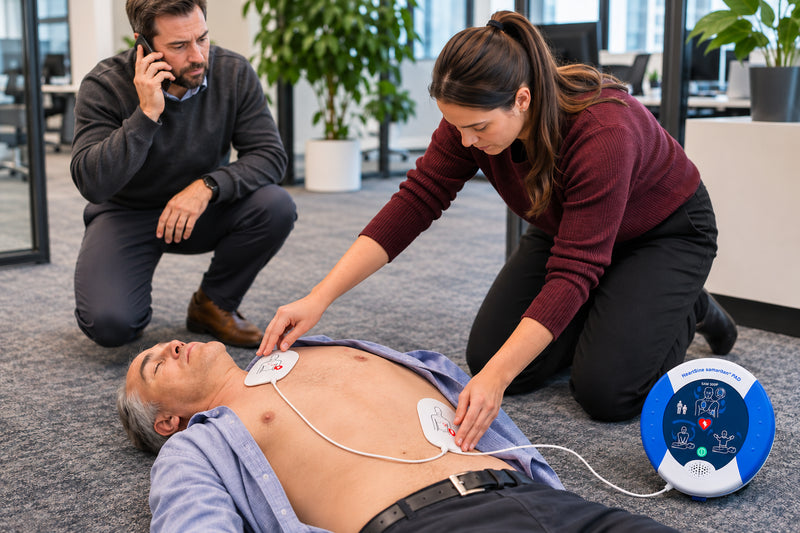
During cardiac arrest, blood flow to the brain and other organs is interrupted. CPR must begin immediately, and an AED should be used as soon as it is available to analyze the heart rhythm and deliver a shock if necessary.
The more time is lost searching for the equipment, the greater the risk of delaying treatment.
It is therefore not enough to calculate the time needed to walk to the defibrillator. You must also account for the return trip to the victim.
In a large building, this detail can completely change the choice of location.
How can you check if your AED is properly placed?
You don't need a complicated study to make an initial assessment.
Imagine a real emergency.
Someone suffers cardiac arrest in your meeting room, workshop, or warehouse. While one colleague calls 911 and begins CPR, another person must go retrieve the defibrillator.
Do the route yourself, stopwatch in hand.
Start from a remote location in the building, go to the AED, take it, and return to the starting point.
Then repeat the exercise from a few other locations: the break room, offices, loading dock, or production area.
You might discover that a device installed in a location that seemed ideal is ultimately much less accessible than expected.
This exercise also helps identify obstacles that are not always considered: a door requiring an access card, an elevator, a cluttered corridor, or a room closed at certain times.
If the retrieval time is too long, you will need to consider another location or adding a second device.
Should a defibrillator be installed on every floor?
Not necessarily.
There is no general rule in Quebec requiring an AED on every floor of all commercial buildings.
The number of devices depends notably on the size, the layout of the premises, and the time required to retrieve them.
In a small two-story building, a single device may be sufficient if it remains quickly accessible to everyone.
In a larger facility, with multiple floors, controlled access, or areas far apart from each other, the situation may be different.
Elevators must also be factored in. Waiting for an elevator to arrive, going down several floors, and coming back up with the AED can take longer than expected.
The right approach is to measure the access time rather than relying solely on the number of floors.
For organizations with multiple buildings, it may be preferable to distribute the defibrillators among different areas rather than grouping them in a single location.
The Canadian Centre for Occupational Health and Safety (CCOHS) recommends evaluating the premises, the people present, and the emergency response plan to determine where to install the devices.
At what height should a defibrillator be installed?
An AED should be placed at a height that makes it easy to see and retrieve.
Avoid mounting it too high, installing it behind furniture, or placing it in a space that is difficult for a person with reduced mobility to access.
You must also consider the weight of the device and its cabinet.
A height that is suitable for a tall person is not necessarily appropriate for all employees.
Before mounting the cabinet on the wall, test it with a few people. Check that they can open the cabinet and remove the defibrillator without difficulty.
For the exact height, refer to the cabinet manufacturer's instructions and the accessibility requirements applicable to your building.
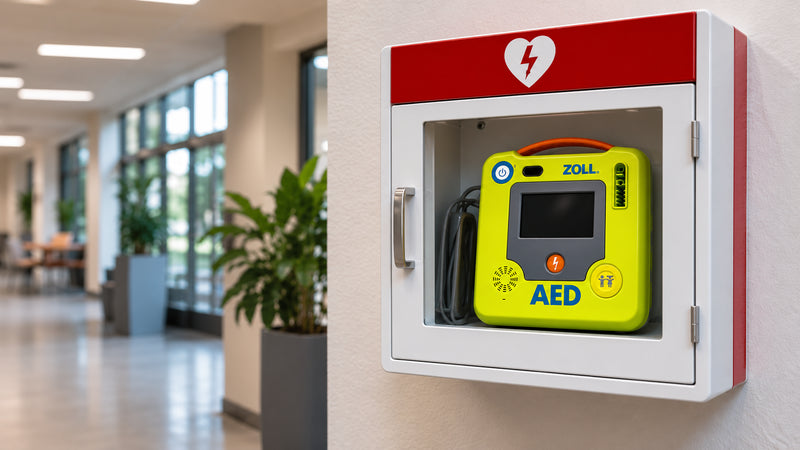
The goal is not only for the AED to be visible. It must also be possible for someone to actually retrieve it quickly[JA1] . It is also recommended to add an "AED" sign above the cabinet so it can be spotted from a distance.
Should the AED be installed in a wall cabinet?
It is not always essential, but a cabinet can be very useful.
In offices, businesses, and public spaces, it allows the device to be stored in a fixed location, protected, and made more visible.
Some models also have an audible alarm that sounds when the door is opened.
In addition to deterring theft, this feature can draw the attention of people nearby when a defibrillator is retrieved[JA2] so that someone can go provide assistance.
There are also cabinets designed for special conditions, particularly for outdoor installations.
At Cardio Choc, we offer different models of AED cabinets and wall boxes, including versions with alarms and heated outdoor boxes.
The choice depends mainly on the environment in which the device will be installed.
A standard indoor cabinet may be suitable for a heated office, but should not be considered sufficient protection against freezing or the elements.
Can a defibrillator be installed outdoors?
Yes, provided appropriate storage is available.
A defibrillator is not necessarily designed to withstand Quebec's winter temperatures or intense summer heat.
Batteries and electrodes have temperature limits that must be respected.
If you wish to install an AED outdoors, you will need to check the device's specifications and choose a box suitable for the local climate.
A heated cabinet may be necessary to protect the device from the cold. However, you must check that it is compatible with the AED, maintains the required conditions, and remains powered and functional.
We explain these precautions in more detail in our article AED and cold: how to protect your defibrillator during the winter season.
You must also provide visible signage and ensure that the box is accessible during the hours when people may need the device.
What locations should be avoided?
A defibrillator should be easy to find, even for someone who is not completely familiar with the premises.
Some locations should therefore be avoided.
A locked office. If the person in charge is away, the device may become inaccessible.
A storage room. An AED placed behind boxes or equipment could be difficult to retrieve quickly.
A low-traffic area. If no one knows where the defibrillator is located, its presence will be much less useful.
A location exposed to unsuitable temperatures. An installation in a vehicle, an unheated warehouse, or outdoors must take into account the device's temperature limits.
An area accessible only during certain hours. If employees work in the evening or on weekends, the AED must also be available during those times.
It may be tempting to choose the most discreet location to preserve the appearance of the premises. However, in this case, visibility is an advantage.
How can you make the defibrillator easy to spot?
Once the location is chosen, you must ensure that employees and visitors can find the device quickly.
A highly visible wall sign, ideally identifiable from a distance or from several directions, can make a real difference.
It is also useful to indicate the AED's location on emergency plans and to inform new employees.
In large buildings, additional signage may be necessary to guide people to the device.
And if you move the AED, remember to update the plans and internal procedures.
We also address the importance of raising awareness among teams in our article Cardiac arrest can happen anywhere. Is your organization ready?.
Once the AED is installed, who should look after it?
The defibrillator's location must also allow for its maintenance.
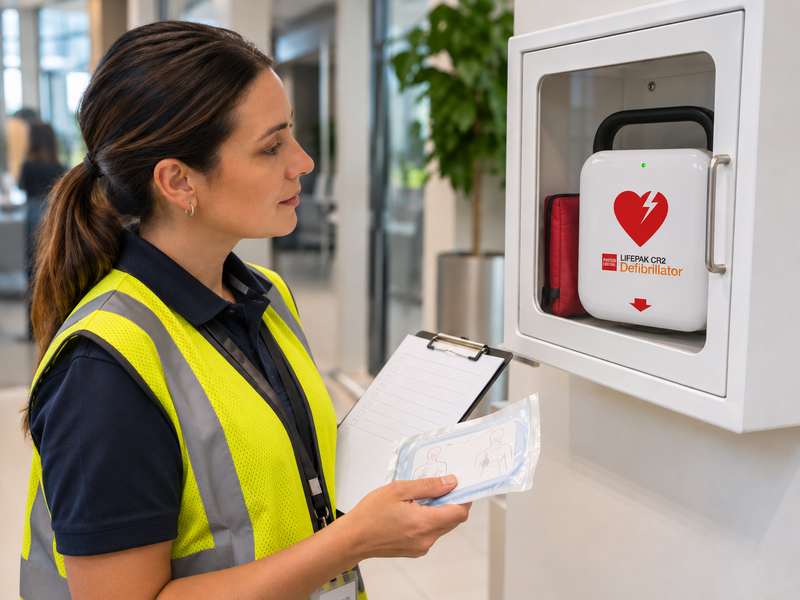
You must be able to easily check its status indicator, verify the expiration dates of the electrodes, and take action when an anomaly is reported.
If your organization has several devices, it also becomes important to keep an accurate record of their locations.
The DefibSync platform from Cardio Choc, among other things, allows you to centralize information about AEDs and track maintenance deadlines.
We also offer an inspection and maintenance service for defibrillators for companies that want to have their equipment checked directly on site.
The best location is the one that saves you time
A defibrillator installed at reception is not necessarily better placed than a device located in a corridor or near a work area.
It all depends on your building, your activities, and the people who are there.
Before deciding, walk the route, measure the retrieval time, and check that the AED remains accessible during all hours of occupancy.
And above all, make sure that employees know its location.
Because in an emergency, it is not the number of defibrillators listed in your inventory that matters. It is how quickly someone can bring one to the victim.
Are you looking for a wall cabinet, a storage solution, or equipment suited to your workplace? Discover the AED cabinets and boxes offered by Cardio Choc.