You have decided to purchase a defibrillator for your business. After doing some research, you quickly discover that prices vary widely from one model to another. Some devices are connected, others offer resuscitation assistance, and the included accessories are not always the same.
How do you know which one is really right for your business?
The good news is that a small business does not necessarily need the most expensive or sophisticated model. However, certain details that are overlooked at the time of purchase can make a real difference, both in terms of long-term costs and the ability to respond quickly in an emergency.
Here are seven mistakes we recommend you avoid.
1. Relying solely on the purchase price
When comparing defibrillators, price is often the first thing we look at. And that's normal. But a $1,000 device is not necessarily more economical than a $1,500 model.
Why? Because electrodes and batteries must be replaced periodically, even if the defibrillator has never been used. Their lifespan and price vary by manufacturer.
You should also look at what is included with the purchase. Some kits include a carrying case or additional accessories, while others are sold with only the essentials.
The Canadian Centre for Occupational Health and Safety (CCOHS) also reminds us of the importance of following manufacturers' recommendations regarding checks, batteries, and electrodes.
Before choosing, take a few minutes to compare costs over several years. A difference of a few hundred dollars today can sometimes be offset by lower maintenance costs.
To better understand prices, also check out our article How much does a defibrillator really cost in Quebec in 2026?
2. Choosing a device without thinking about where it will be installed
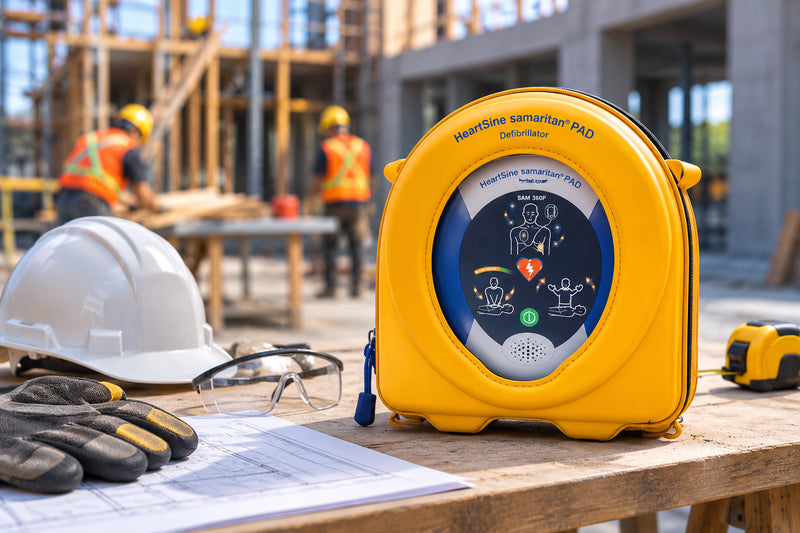
A defibrillator intended for a professional office does not necessarily need the same features as one installed in a warehouse or mechanical workshop.
Dust, humidity, and temperature variations can influence the choice of model.
For example, if your business has an unheated warehouse, you will need to check the manufacturer's recommended storage temperatures. A device designed to be stored at room temperature should not be left in an environment that exceeds its limits.
Water and dust resistance also varies from one defibrillator to another.
The ZOLL AED Plus, for example, has an IP55 protection rating, which indicates resistance to dust and water splashes. This feature is confirmed in the ZOLL manufacturer specifications.
These are details that are not always considered, but which can have an impact on the reliability of the device.
To compare the features of the different models, check out our guide What is the best defibrillator for your business in 2026?.
3. Waiting until you have received the defibrillator to decide where to place it
It may seem trivial, but the location of a defibrillator deserves consideration even before purchasing it.
Imagine that an employee suffers a cardiac arrest in your warehouse. The AED is in the administrative office, at the other end of the building. You have to go through several corridors, find someone who has access to the office, and come back with the device.
Meanwhile, minutes are ticking by.
A defibrillator should be installed in a visible, easily accessible location that is known to employees. Avoid locked offices or spaces that only a handful of people can access.
If your business occupies multiple floors or has different buildings, it may also be relevant to install more than one device.
The CCOHS recommends, in particular, taking into account the location of the devices, the people present, and the emergency response plan when an organization decides to equip itself with an AED.
The idea is not simply to have a defibrillator on site, but to be able to retrieve it quickly when needed.
4. Forgetting that electrodes and batteries have a limited lifespan
This is probably one of the most common surprises for new AED owners.
Contrary to what you might think, a defibrillator that has never been used is not necessarily ready to work indefinitely.
Electrodes have an expiration date. Batteries must also be replaced according to the manufacturer's instructions.
And costs vary from one model to another.
For example, ZOLL indicates that CPR-D-padz electrodes and the batteries for its AED Plus can offer a lifespan of up to five years, depending on usage and storage conditions. Other devices have different timeframes.
Before purchasing, check how much consumables cost and how often they will need to be replaced. Also make sure they are readily available in Canada.
This information will help you better plan your expenses, but also avoid ending up with a device whose accessories are difficult to obtain.
Do you already own an AED? Our article AED Maintenance and Inspection: Is Your Defibrillator Ready to Respond? explains the main checks to perform.
5. Thinking that all defibrillators offer the same assistance
Most automated external defibrillators (AEDs) are designed to be used by people who do not have medical training. They analyze the heart rhythm and provide instructions to guide the intervention.
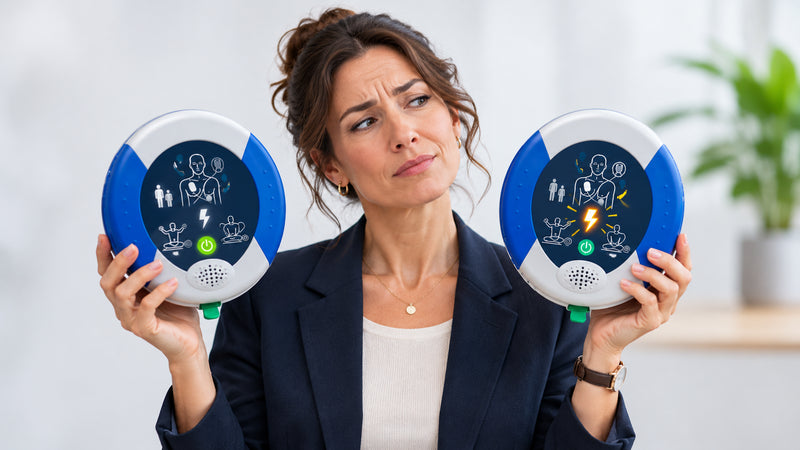
But not all devices offer exactly the same features.
Some primarily offer voice instructions. Others add visual cues or a metronome to help maintain the rhythm of chest compressions.
The Philips HeartStart OnSite, for example, offers voice instructions and a metronome to guide the responder during CPR, as stated by Philips on its official website.
Other models, such as the ZOLL AED Plus, go further with their Real CPR Help technology, which provides feedback on the depth and rate of chest compressions.
Is it essential for all businesses? Not necessarily.
For a small office, a simple, easy-to-use defibrillator may be perfectly suitable. In an environment where you want to offer more assistance to responders, some additional features may be interesting.
The important thing is to understand what the device really offers and to choose based on your team's needs.
6. Not planning for anyone to take care of maintenance
You buy the defibrillator, mount it on the wall, and hope you never have to use it.
But a few years later, who remembers the expiration date of the electrodes? Who checks if the battery needs to be replaced? And who takes care of the device when a warning light comes on?
In a small business, this kind of responsibility can easily fall through the cracks, especially when someone leaves the company.
There is no need to set up a complicated system. The main thing is to designate someone who will be responsible for monitoring and to plan regular checks, according to the manufacturer's recommendations.
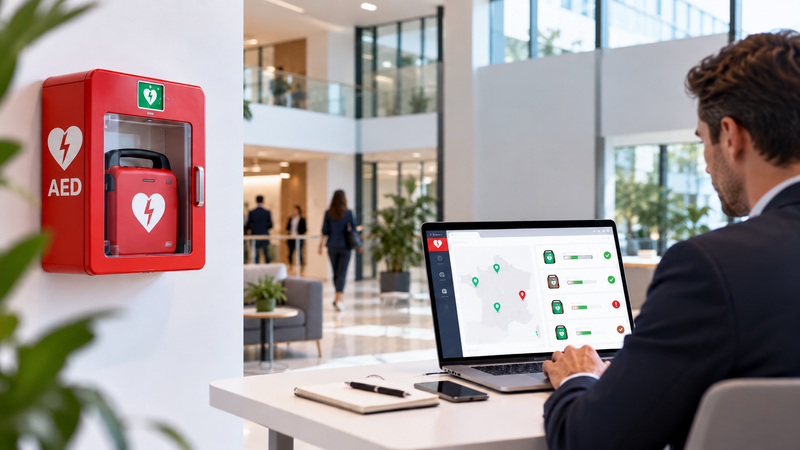
There are also management tools, such as Cardio Choc's DefibSync, which allow you to centralize information about the devices and receive reminders for important deadlines.
For organizations that prefer to entrust this task to specialists, Cardio Choc also offers an AED inspection and maintenance service, directly on site.
Because a defibrillator that has been installed for five years, but whose condition no one checks, is not particularly reassuring.
7. Installing a defibrillator without talking to employees
Your AED is installed, the electrodes are up to date, and the device is ready to work.
But do your employees know where it is?
And above all, would they know what to do if a colleague collapsed in front of them?
Having a defibrillator is an excellent preventive measure. The people present must also know that it exists and be able to find it quickly.
Take the time to show employees its location and briefly explain how it works. Cardiopulmonary resuscitation (CPR) and AED use training is also recommended.
Even though defibrillators are designed to guide users, a person who already knows the basic steps will generally be better prepared to respond.
The CCOHS also recommends integrating AEDs into emergency preparedness and providing appropriate training for employees.
In the event of a suspected cardiac arrest, you must call 911, start CPR without delay, and use the AED as soon as it is available, following its instructions.
So, how do you choose the right defibrillator for your small business?
The best choice is not necessarily the device with the most features. It is the one that suits your environment, your budget, and the reality of your business.
Before making a purchase, make sure you can answer these few questions:
- Where will the defibrillator be installed, and who will have access to it?
- Do the device's features suit our workplace?
- How much will batteries and electrodes cost in the long term?
- Who will be responsible for its maintenance?
- Will employees know where to find it and how to respond?
If these elements are clear, you are already well on your way to making a decision.
At Cardio Choc, we help businesses choose a defibrillator suited to their needs, whether it is a small office, a retail store, or an industrial environment.
Are you hesitating between several models? Discover our selection of defibrillators or contact our team for advice.