On a construction site, working conditions are rarely ideal for an electronic device. There is dust, moisture, vibration, equipment movement and, of course, the temperature fluctuations we know so well in Canada.
So, when a company wants to equip itself with a defibrillator, can it choose any model?
Not exactly.
An automated external defibrillator (AED) intended for a construction site must be chosen based on its ruggedness, storage conditions and ease of access. It must also be easy to use, even when the intervention takes place in a noisy or difficult environment.
Here are the elements to consider before equipping your construction site.
Can an ordinary defibrillator be used on a construction site?
Yes. A defibrillator designed for businesses can also be suitable for a construction site, provided that its features are adapted to the conditions in which it will be stored and used.
But you need to pay attention to certain details.
A device installed in a heated office does not undergo the same constraints as an AED transported in a pickup truck or stored in a construction trailer.
Exposure to cold, heat and moisture can notably affect the batteries, electrodes and certain components of the device.
This is why it is not enough to look at the price or choose a popular model. You must also check the manufacturer's technical specifications.
1. Resistance to dust and moisture
On a construction site, dust is part of everyday life. Depending on the work, the equipment may also be exposed to moisture, water splashes or more demanding conditions.
Not all defibrillators offer the same level of protection.
To compare them, you can notably look at their IP rating, which indicates their resistance to the penetration of solid bodies and water according to standardized tests.
For example, a device certified IP55 offers protection against dust and water jets. But some models go even further.
This is notably the case of HeartSine samaritan PAD defibrillators, which have an IP56 rating, offering protection against dust and powerful water jets. This feature represents an interesting advantage for demanding environments such as construction sites.
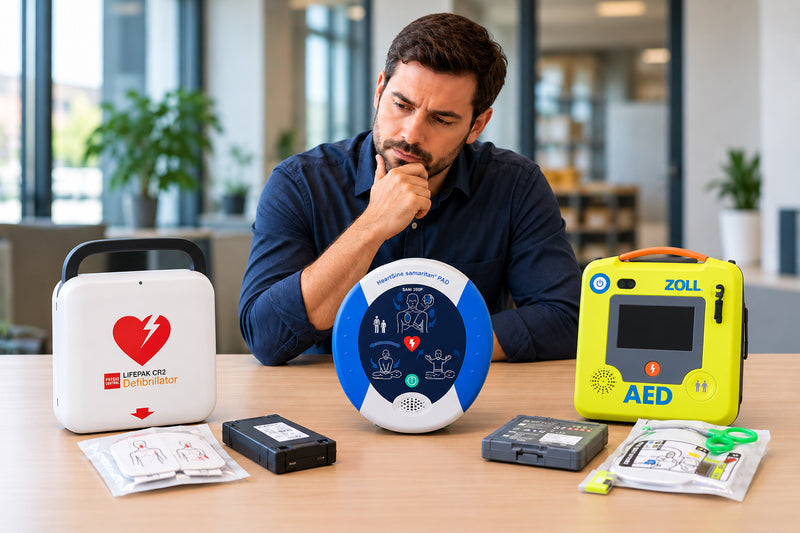
The HeartSine samaritan PAD 360P and the HeartSine samaritan PAD 500P are notably among the models to consider.
However, this does not mean that they can be submerged or left outside without protection. The place where the device will be stored remains just as important.
2. Storage temperature: a detail not to be overlooked
The Canadian winter poses a particular challenge.
An AED can end up in a trailer whose heating is turned off at night, in a metal container or in a vehicle parked outside for several hours.
And in the summer, these same spaces can become extremely hot.
Manufacturers specify temperature ranges for the use and storage of their devices. These limits are not necessarily the same from one model to another.
Before purchasing, check the allowed temperatures for the AED, but also for its electrodes and battery.
A high IP protection rating does not mean that a defibrillator can withstand freezing. Even a rugged device like the HeartSine samaritan must be stored in the temperature conditions recommended by its manufacturer.
If you plan to store a defibrillator outside, you will need to provide a suitable cabinet, with thermal protection appropriate for local conditions.
We address this question more precisely in our article AED and cold: how to protect your defibrillator during the winter season.
3. A device that is easy to use, even in a noisy environment
A cardiac arrest on a construction site can occur in a space where there is a lot of noise, workers scattered and several pieces of equipment in motion.
In this context, the voice instructions of a defibrillator are important, but visual indications can also be useful.
Some models display pictograms that allow you to follow the steps of the intervention. Others offer additional assistance during chest compressions.
The HeartSine samaritan PAD 360P and 500P defibrillators notably combine voice instructions and visual indications to guide the user.
The HeartSine samaritan PAD 500P goes a little further thanks to its CPR Advisor technology, which provides real-time feedback to help the rescuer adjust their chest compressions.
This type of assistance can be interesting for workers who have received CPR training, but who have never had to intervene in a real emergency situation.
That said, you should not assume that a more sophisticated device will automatically be more suitable.
The important thing is that the responders can quickly understand the instructions and use the AED in the real conditions of their workplace.
4. Where to install a defibrillator on a construction site?
This is a question that deserves to be settled even before the delivery of the device.
On a construction site, workers do not necessarily spend their whole day in the same place. Some work inside, others outside, and the activity zones can change as the work progresses.
Installing the defibrillator in a construction trailer may seem logical. But this trailer must be accessible when work is underway.
If it is locked, far from certain areas or difficult to spot, the location could slow down the intervention.
The Canadian Centre for Occupational Health and Safety (CCOHS) also recommends taking into account the layout of the premises, the people present and the emergency plans when an organization determines where to install its AEDs.
On a construction site, this may mean reviewing the location of the device as the work progresses.
The goal is that workers know where to find it and can access it quickly, without having to search for the person who holds a key.
For large construction sites or projects spread over several zones, it may also be relevant to assess the need to have more than one device.
5. Who should take care of the defibrillator during the work?
On a construction site, teams change, subcontractors follow one another and temporary installations are sometimes moved.
Without anyone responsible, the monitoring of a defibrillator can easily be forgotten.
It is therefore preferable to designate someone who will ensure that the device remains accessible, in good condition and ready to be used.
This person can notably check its status indicator, monitor the expiration dates of the electrodes and report anomalies.
The CCOHS recommends following the manufacturer's instructions regarding inspection and maintenance, as well as keeping a record of the checks performed.
For contractors who manage several construction sites, this monitoring can become more complex.
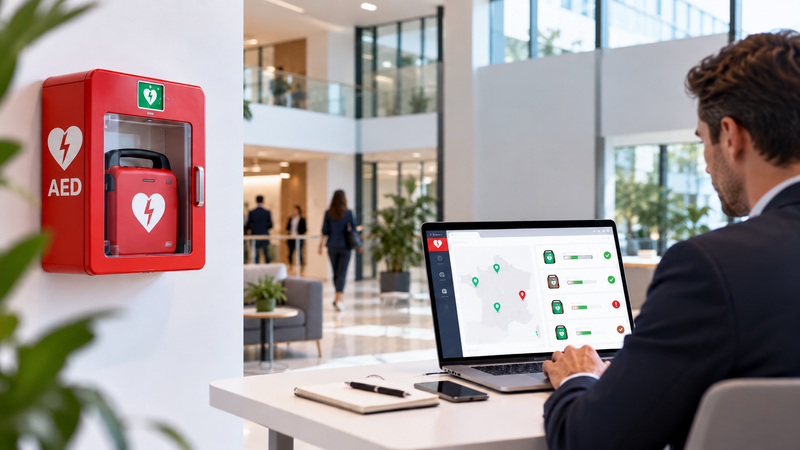
A platform like DefibSync allows to centralize the information on the different AEDs, track deadlines and facilitate their management.
This can notably prevent a device from being moved from one construction site to another without its tracking information being updated.
Is it mandatory to have a defibrillator on a construction site in Quebec?
In Quebec, there is no general obligation imposing an AED on all construction sites.
Employers must nevertheless comply with the applicable requirements in health and safety as well as first aid.
You must also check the requirements specific to the construction site and its activities.
The situation is different in Ontario, where a regulation provides for the presence of an AED on certain construction sites meeting specific criteria.
We have also dedicated an article to the new Ontario requirements regarding AEDs on construction sites.
For a Quebec company, the installation of an AED can therefore be a prevention decision, even when no special provision requires it.
Which defibrillator to choose for a construction site?
There is no single model that suits all construction sites.
A contractor who works mainly in already heated buildings will not necessarily have the same needs as a company specializing in road work or outdoor construction sites.
Here are the features we would look at first:
| Criterion | What to look for |
|---|---|
| Ruggedness | Resistance adapted to dust and moisture |
| Temperature | Storage conditions compatible with the construction site |
| Use | Clear voice instructions and visual indications |
| Transport | Device and case easy to move as needed |
| Maintenance | Availability of batteries and electrodes |
| Accessibility | Visible, secure and quickly accessible storage |
The HeartSine samaritan PAD 360P and 500P are particularly interesting for construction sites.
Their IP56 protection rating, compact format and ease of use make them suitable options for demanding environments. They are also equipped with the Pad-Pak system, which combines the electrodes and the battery in a single cartridge, thus simplifying their replacement.
The choice between the two models will notably depend on the desired level of assistance during the intervention.
-
HeartSine samaritan PAD 360P: a fully automatic model, with voice and visual instructions.
-
HeartSine samaritan PAD 500P: a semi-automatic model that also offers real-time feedback on chest compressions.
Other defibrillators may also be suitable depending on the working conditions and the company's needs.
To discover the devices and kits offered for this type of environment, consult our selection of defibrillators for construction and construction sites.
You can also consult our article What is the best defibrillator for your company in 2026? to compare the features of the different models.
A well-equipped construction site is also a team that knows how to react
Buying a defibrillator is a good decision. But you must also think about what will happen the day someone needs to use it.
Do the workers know its location? Do the day and evening teams have access to it? And if the work moves to another area, will the device follow?
These questions are just as important as the choice of the model.
Cardiopulmonary resuscitation (CPR) and AED use training also allows to better prepare workers to intervene in emergency situations.
At Cardio Choc, we support companies in the choice of their defibrillators and solutions adapted to their environment.
Do you want to equip a construction site? Discover our range of defibrillators for construction sites or contact our team to choose a device adapted to your working conditions.