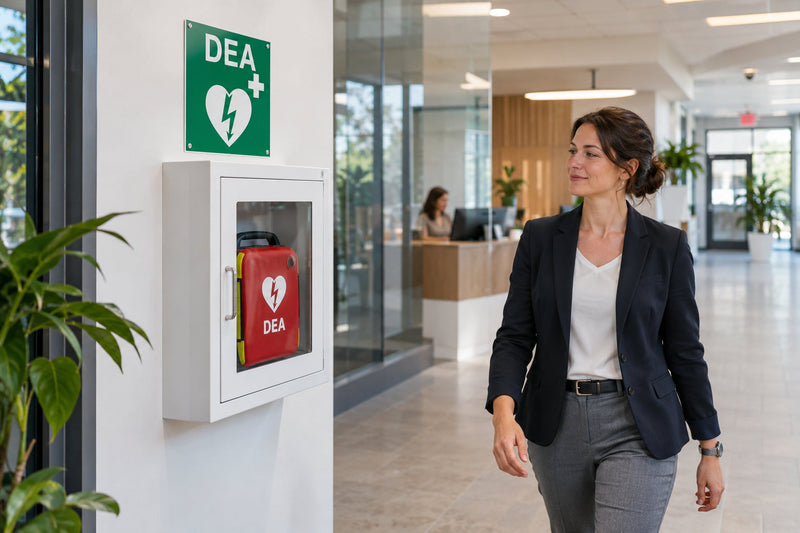
They are increasingly common in businesses, schools, arenas, and public places. Generally installed in an easily recognizable wall-mounted cabinet, the defibrillator has become an important piece of equipment for responding quickly to a cardiac emergency.
But do you know exactly what this device is used for? How does it work? And above all, do you need medical training to use it?
Here is what you need to know about automated external defibrillators (AEDs), how they work, how to use them, and the factors to consider when equipping yourself properly.
What is an AED?
An AED, or automated external defibrillator, is a portable medical device designed to analyze the heart rhythm of a person in cardiac arrest and, when necessary, deliver an electric shock to try to restore an effective heart rhythm.
Unlike manual defibrillators used by healthcare professionals, the AED is designed to be used by the general public, even without any particular medical knowledge.
Once turned on, the device guides the user with voice instructions and, depending on the model, visual prompts.
It automatically analyzes the electrical activity of the heart and determines whether a shock is necessary.
An AED does not deliver a shock when the analyzed heart rhythm does not warrant defibrillation.
This is what makes it a particularly useful piece of equipment in businesses and public places, where the first people to respond are not necessarily healthcare professionals.
What is a defibrillator used for?
A defibrillator is used to respond to certain types of cardiac arrest.
To understand its purpose, you need to know that the heart works thanks to a natural electrical system that coordinates its contractions.
When this system is disrupted, the heart can start beating in a completely disorganized manner. In certain situations, it can no longer pump blood effectively to the brain and other vital organs.
This is what happens, in particular, during ventricular fibrillation, a rhythm disorder that can cause cardiac arrest.
The defibrillator can then deliver an electric shock intended to interrupt this abnormal electrical activity and allow the heart to regain an effective rhythm.
However, it is important to understand that an AED does not treat all types of cardiac arrest. Some rhythms do not require an electric shock.
This is why the device always analyzes the heart rhythm before determining whether defibrillation is indicated.
Even when no shock is recommended, cardiopulmonary resuscitation (CPR) maneuvers remain essential.
What is the difference between cardiac arrest and a heart attack?
These two situations are often confused, but they do not refer to the same medical emergency.
A heart attack, also called a myocardial infarction, generally occurs when an artery supplying the heart muscle is blocked.
Cardiac arrest occurs when the heart suddenly stops pumping blood effectively.
|
Heart attack |
Cardiac arrest |
|
Problem mainly related to blood circulation in the heart arteries |
Problem leading to the cessation of blood circulation |
|
The person is often conscious |
The person loses consciousness and does not respond |
|
Can cause chest pain, nausea, or shortness of breath |
The person is not breathing normally or is no longer breathing |
|
Requires urgent medical intervention |
Requires immediate CPR and an AED as soon as one is available |
A heart attack can sometimes lead to cardiac arrest, but this is not always the case.
The AED is designed to respond to cardiac arrest, not to directly treat a heart attack in a person who is still conscious.
How does an AED work?
Even though models differ by manufacturer, automated external defibrillators operate on the same principle.
Their operation involves three main steps.
1. Heart rhythm analysis
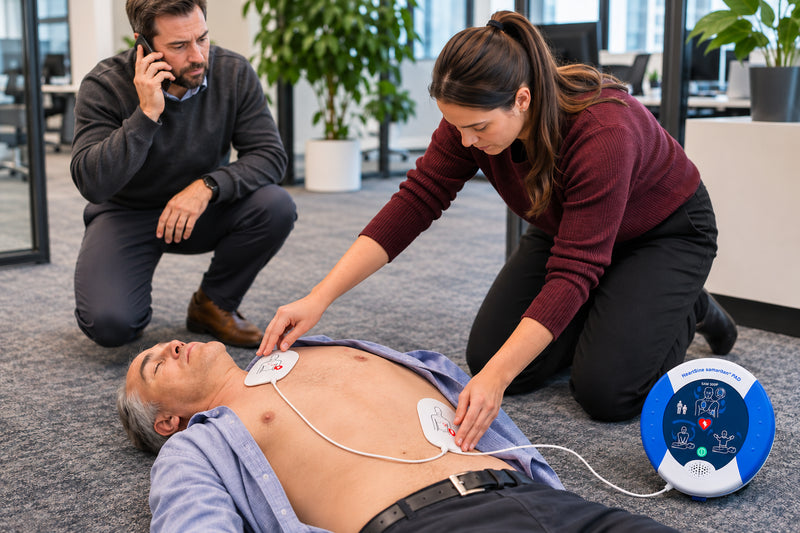
After turning on the device, the user places two adhesive electrodes on the person's bare chest, following the provided illustrations.
These electrodes allow the AED to measure the electrical activity of the heart.
The device then analyzes the heart rhythm to determine whether an electric shock is necessary.
During this analysis, no one should touch the victim so as not to disrupt the reading.
2. The decision to deliver a shock
If the device detects a rhythm that can be treated by defibrillation, it prepares to deliver a shock.
Depending on the model, it will be delivered automatically or after the user presses a button.
If no shock is indicated, the AED informs the user and asks them to continue resuscitation maneuvers.
3. Guidance during resuscitation
The AED's role is not limited to delivering a shock.
The device also guides the user through the different steps of the intervention.
Some models have CPR assistance features that provide guidance on the rhythm or depth of chest compressions.
These features can be particularly useful for someone who has to respond to a stressful situation.
How do you use an AED in an emergency?
When a person suddenly collapses, does not respond, and is not breathing normally, you must act immediately.
Here are the main steps to follow.
1. Check the person's responsiveness and breathing.
If they are unconscious and not breathing normally, consider that they may be in cardiac arrest. Abnormal breathing or occasional gasping should not be considered normal breathing.
2. Call 911 immediately.
Put your phone on speaker mode to follow the instructions of emergency services.
If other people are present, ask someone to go get an AED.
3. Start CPR.
Perform firm, fast chest compressions in the center of the chest, at a rate of 100 to 120 compressions per minute for an adult.
Follow the instructions of the 911 dispatcher.
4. Turn on the AED as soon as it is available.
The device will tell you the steps to follow.
5. Place the electrodes on the bare chest.
Follow the illustrations on the electrodes. If the chest is wet, dry it before applying them.
6. Let the AED analyze the heart rhythm.
Make sure no one touches the victim during the analysis.
If a shock is recommended, follow the device's instructions and make sure no one touches the person at the time it is delivered.
7. Resume CPR and continue following the instructions.
Continue the maneuvers according to the instructions of the AED and the dispatcher, until emergency services take over or until the person shows signs of life.
The important thing is not to wait for the defibrillator to arrive before starting chest compressions.
CPR helps maintain some blood circulation to the brain and vital organs, while the AED can treat certain abnormal heart rhythms.
The two interventions complement each other.
Can you use an AED without training?
Yes. An AED is designed to be used by someone who has not received medical training.
In Quebec, specific training is not mandatory to use an AED in an emergency.
The voice and visual instructions guide the user during the intervention.
It is therefore not necessary to be a doctor, nurse, or paramedic to use an automated external defibrillator.
That said, taking a CPR and AED training course remains highly recommended.
Training allows you, in particular, to learn how to quickly recognize cardiac arrest, perform chest compressions correctly, and respond in a more structured way to an emergency situation.
It also allows you to become familiar with how an AED works before having to use it in real circumstances.
Can a defibrillator deliver a shock by mistake?
The AED is designed to analyze the heart rhythm and recommend defibrillation only when it detects a rhythm that requires a shock.
For example, if the device detects a rhythm that cannot be treated by defibrillation, it will not authorize the delivery of a shock.
This automatic analysis considerably reduces the risk of an inappropriate intervention.
However, you must follow all the device's instructions, especially the instructions asking you not to touch the person during the analysis and the delivery of the shock.
What is the difference between an automatic and a semi-automatic AED?
There are mainly two types of automated external defibrillators.
The semi-automatic AED analyzes the heart rhythm and indicates when a shock is necessary. The user must then press a button to deliver the shock.
The fully automatic AED also analyzes the heart rhythm, but delivers the shock without the user having to press a button, after issuing the appropriate warnings.
In both cases, the device determines for itself whether defibrillation is indicated.
The choice between these two technologies depends in particular on the organization's preferences, the environment in which it is used, and the features of the devices offered.
Can you use a defibrillator on a child?
Yes, an AED can be used on a child in cardiac arrest.
However, the terms of use depend on their age, size, and the model of the defibrillator.
Some devices have pediatric electrodes that reduce the shock energy. Others have a child mode or a system that allows the treatment to be adapted.
For children under eight years old, it is preferable to use a mode or pediatric electrodes when they are available.
If no pediatric equipment is accessible, defibrillation should not be delayed: an AED equipped with adult electrodes can be used by following the recommendations of emergency services.
It is essential to follow the manufacturer's instructions and position the electrodes so that they do not touch each other.
Organizations that regularly welcome children, such as schools, daycares, and sports centers, should pay particular attention to pediatric features when choosing their defibrillator.
Where should a defibrillator be installed?
Today, AEDs are found in several types of environments: businesses, offices, schools, sports centers, arenas, hotels, shopping malls, and public buildings.
Their presence is particularly relevant in places where many people circulate, where physical activities are practiced, or when emergency services' response times may be longer.
But owning a defibrillator is not enough.
People must also know where it is and be able to access it quickly.
A device installed in a locked office, a rarely visited room, or a hard-to-reach place is likely to be much less useful during an emergency.
Location, signage, and accessibility must therefore be part of any installation process.
It is also recommended to register the devices in the AED-Quebec registry to make them easier to locate.
How many defibrillators should be installed in a building?
The number of AEDs needed depends on several factors: the size of the building, the number of floors, the number of people present, and the activities taking place there.
For example, a small single-story office will not have the same needs as a three-story school, a sports center, or a large industrial facility.
The goal is to allow someone to quickly retrieve a defibrillator and return to the victim.
To achieve this, you must take into account the distances to be covered, stairs, locked doors, and other obstacles that could slow down the intervention.
You do not know how many AEDs to plan for in your establishment?
Cardio Choc provides you with a free tool that estimates the recommended number of devices according to the characteristics of your building.
Use our calculator to find out how many AEDs to install in your establishment.
The tool takes into account, in particular, the type of building, its size, the number of floors, the number of occupants, and the presence of sports facilities.
This estimate is a starting point and does not replace an assessment of the actual accessibility of the devices.
Is it mandatory to have an AED in a business in Quebec?
In Quebec, there is no general obligation requiring all businesses to own an automated external defibrillator.
However, some facilities or activities may be subject to particular requirements depending on their sector or the applicable regulations.
Even when no obligation applies, several organizations choose to install an AED as part of their emergency preparedness measures.
The choice depends in particular on the size of the business, the number of employees, the frequency of visits to the premises, the activities carried out, and the accessibility of emergency medical services.
For an employer, the question therefore deserves to be addressed from a broader perspective of occupational health and safety.
An AED is not just a device to buy: it must be integrated into an intervention plan known by the employees.
How much does a defibrillator cost in Quebec?
The price of a defibrillator varies depending on the manufacturer, the model, the features, and the services included.
In Quebec, new AEDs generally sell for between $1,900 and $2,600, sometimes more depending on the device's features. Some recertified models may be available for less than $1,000.
These ranges are indicative and may change depending on promotions, models, and included equipment.
But the purchase price is only part of the budget to plan for.
Electrodes and batteries must be replaced periodically. You must also consider accessories, installation, and potential maintenance services.
Two defibrillators sold at similar prices can therefore have different costs after several years of use.
To learn about the price ranges, compare new and recertified models, and better understand the factors that influence their cost, consult our comprehensive guide to defibrillator prices in Quebec.
What is the real cost of an AED over 2, 5, or 10 years?
When choosing a defibrillator, it is relevant to look beyond the initial invoice.
Some models have electrodes with a lifespan of about two years, while others use consumables that can last four or five years.
These differences influence the expenses to plan for over the years.
To facilitate this comparison, Cardio Choc offers a calculator that allows you to estimate the total cost of ownership of an AED over the period of your choice.
The tool takes into account the purchase price, the replacement of electrodes and batteries, the number of devices, and certain additional options, such as pediatric accessories.
You can thus compare the estimated expenses in the short, medium, or long term.
Calculate the total cost of your defibrillator over several years thanks to our free estimator.
It is a more informed way to compare models, particularly for businesses and organizations that wish to plan their equipment budget.
The results are indicative and do not replace a quote tailored to your needs.
How long does an AED last?
A defibrillator can remain functional for several years, but its actual lifespan depends on various factors.
The model, storage conditions, frequency of use, availability of parts, and manufacturer recommendations all play a role.
You must also distinguish the lifespan of the device from that of its components.
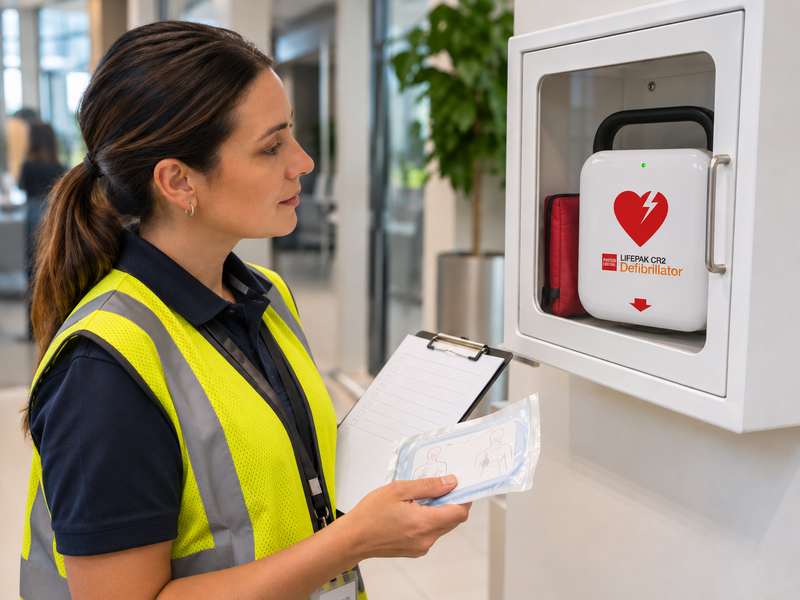
Electrodes have an expiration date, even if they have never been used. They must also be replaced after use, according to the manufacturer's instructions.
The battery must also be monitored and replaced according to the recommendations applicable to the model.
A device that appears to be in good condition on the outside is therefore not necessarily ready to function.
Why should a defibrillator be maintained?
An AED can remain unused for months, or even years.
During this time, its battery ages, its electrodes approach their expiration date, and operating problems can occur.
Even though several defibrillators automatically perform self-tests, these built-in checks do not entirely replace a maintenance program.
You must notably check:
- The device's operating status indicator.
- The expiration date of the electrodes.
- The condition and lifespan of the battery.
- The presence of the necessary accessories.
- The storage conditions.
- The accessibility of the defibrillator.
It is also recommended to designate a person responsible for monitoring and to keep a log of the checks performed.
For organizations that own several devices or that must manage different sites, a centralized monitoring solution can facilitate the monitoring of maintenance deadlines.
Cardio Choc offers, among other things, defibrillator inspection and maintenance services, as well as management solutions to simplify equipment monitoring.
How to choose a defibrillator suited to your needs?
All automated external defibrillators pursue the same goal: to allow a rapid intervention in case of cardiac arrest.
However, they do not all have the same features.
Before choosing a device, several elements deserve to be evaluated.
Ease of use
Voice instructions, illustrations, and the ergonomics of the device can influence the ease with which a person will intervene.
The installation environment
A defibrillator intended for an office will not necessarily have the same requirements as a device used on a construction site, in a factory, or outdoors.
Resistance to water, dust, and environmental conditions can be an important criterion.
CPR assistance
Some models offer additional indications to help the user perform chest compressions.
Pediatric features
The presence of a child mode or suitable electrodes can be important in environments welcoming young users.
Maintenance and consumables
The lifespan of the electrodes and batteries, their replacement cost, as well as the warranties, are criteria to consider.
Connectivity
Some devices offer a Wi-Fi or cellular connection that allows the transmission of information about their status and facilitates their monitoring.
These features can notably be interesting for organizations owning several defibrillators distributed in different establishments.
Which AED to choose for your business or organization?
The best defibrillator is not necessarily the most expensive nor the one that has the most features.
A device intended for an office environment can meet very different needs from those of a construction site, an arena, or a school.
The choice must take into account the environment, the potential users, the presence of children, the language of the instructions, and the truly useful features.
To simplify this decision, Cardio Choc has developed an interactive guide that helps you identify the models best suited to your situation.
By answering only five questions, you get a selection of three defibrillators matching your needs, from the available models.
Discover our interactive guide to find the defibrillator suited to your environment.
You prefer to compare the devices directly? You can also view our complete selection of automated external defibrillators, including new and recertified models from different manufacturers.
Frequently asked questions about AEDs
What does the abbreviation AED mean?
AED stands for "automated external defibrillator". It is a portable medical device designed to analyze the heart rhythm and administer, when necessary, an electric shock to a person in cardiac arrest.
Can an AED save a person in cardiac arrest?
Yes. When cardiac arrest is caused by a rhythm that can be treated by defibrillation, an AED can help restore an effective heart rhythm. Its rapid use, combined with CPR, increases the chances of survival.
Does an AED work on a person whose heart is no longer beating?
It depends on the heart rhythm present. An AED can treat certain abnormal rhythms, notably ventricular fibrillation and certain pulseless ventricular tachycardias. However, it does not recommend a shock for all types of cardiac arrest.
Is training required to use an AED?
No. An AED is designed to be used by the general public and provides voice or visual instructions. However, training in CPR and AED use remains recommended to intervene more effectively.
Does an AED replace CPR?
No. CPR allows maintaining a minimum blood circulation to vital organs, while the AED can treat certain heart rhythm disorders. The two interventions are complementary.
Can an AED be used in the rain?
It is possible to use an AED in different conditions, but safety instructions must be followed. The chest must be dried before installing the electrodes, and situations where the person is in the water must be avoided. The manufacturer's recommendations must be followed.
What is the difference between an AED and an AED?
There is none. AED is the French abbreviation for "automated external defibrillator", while AED means "Automated External Defibrillator" in English. Both terms refer to the same type of device.
Where to find an AED in case of emergency in Quebec?
AEDs are often installed in public buildings, schools, businesses, and sports centers. The AED-Québec app also allows locating devices registered in the provincial registry. In case of cardiac arrest, immediately dial 911 and follow the dispatcher's instructions.
A simple piece of equipment that can make all the difference
When a person suffers a cardiac arrest, the first few minutes are decisive.
The presence of an accessible defibrillator, combined with people capable of recognizing an emergency and starting CPR, can change the outcome of an intervention.
This is why it is important not to consider the AED as a simple piece of equipment installed on the wall.
Its location, operating condition, maintenance, and the preparation of the people likely to use it are just as important as the device itself.
At Cardio Choc, we support businesses and organizations in the choice, installation, and monitoring of their defibrillators, so that they have equipment suited to their needs and ready to intervene.
Whether you wish to install your first device, equip several establishments, or replace an existing defibrillator, the first step consists of properly assessing your needs.
You don't know where to start? Use our interactive guide to choose your AED or discover the defibrillators offered at Cardio Choc.
Our team is also available to advise you in the choice of equipment suited to your environment.