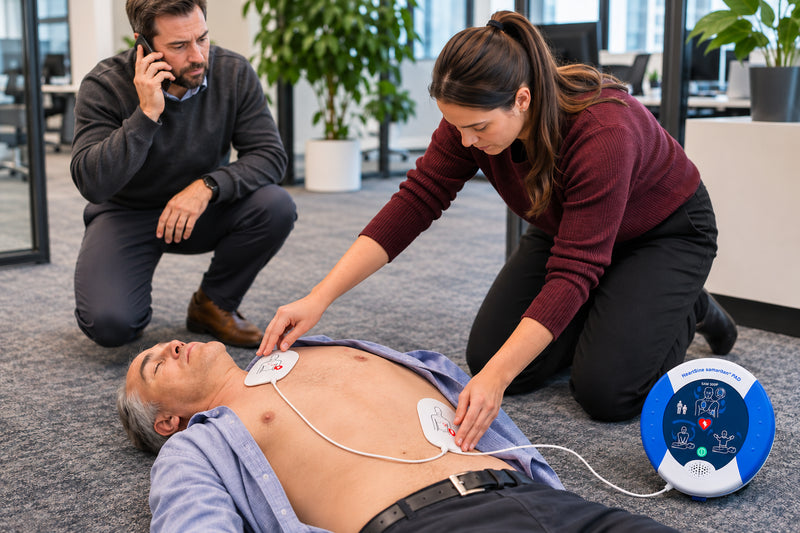
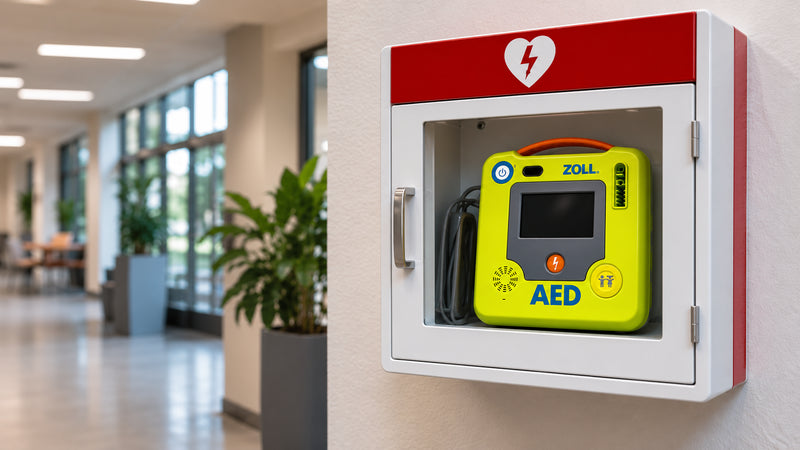
You pass by the defibrillator installed in your company almost every day. It is mounted on the wall, clearly visible, and no one has needed to use it since it was installed.
But are you sure it still works?
This is a question that many managers eventually ask themselves, especially when the device has been in place for several years.
An automated external defibrillator (AED) can go unused for a long time. During this time, its battery ages, its electrodes approach their expiration date, and some issues may go unnoticed.
Fortunately, all AEDs have a status indicator and perform [CG1] self-tests to report certain operating problems. The challenge is knowing what to look for.
The first thing to do: check the status indicator
This is generally the easiest check to perform.
On most defibrillators, a light, a status window, or a symbol indicates whether the device has successfully completed its latest automatic checks.
This indicator varies by brand.
On a Philips HeartStart OnSite, for example, a flashing green light indicates that the device is ready to use.
On a ZOLL AED Plus, a green check mark appears in the status window when the automatic checks are successful.
The HeartSine samaritan PAD 350P, 360P, and 500P models use a flashing green light to indicate their availability status.
This information is documented by the manufacturers in their technical resources: Philips HeartStart OnSite, ZOLL AED Plus, and HeartSine.
A green light or green check mark is therefore generally reassuring, but it is not enough to confirm that all the equipment is in order.
Electrodes, for example, could be approaching their expiration date without all models being able to detect it automatically.
What do the lights mean on the different models?
Here are some guidelines for devices commonly used in businesses.
|
Defibrillator |
Normal indication |
Signal to check |
|
Philips HeartStart OnSite |
Flashing green light |
Light is off, audible alarm, or other anomaly |
|
ZOLL AED Plus |
Green check mark in the status window |
Red X or audible alert |
|
HeartSine samaritan PAD |
Flashing green light |
Flashing red light or other anomaly |
|
LIFEPAK CR2 |
“OK” status indicator depending on the model |
Non-compliant indicator or alert |
These indications are general guidelines. Your model’s manual remains the reference for correctly interpreting the lights, messages, and actions to take.
If an indicator seems unusual, it is better to check it immediately rather than assuming it is a minor issue.
Can a defibrillator detect its own failure?
Yes, partially.
Modern AEDs perform self-tests to check several essential components of their operation.
Depending on the model, these checks may include electronic circuits, the battery, certain defibrillation-related functions, and electrode connections.
The Philips HeartStart OnSite, for example, performs daily self-tests. The manufacturer states that they monitor several components of the device, including internal circuits and battery capacity.
This is a useful feature, especially for equipment that is rarely used.
But it is important to understand the limitations of these tests.
A successful self-test does not replace regular checks of the electrodes, accessories, and the overall condition of the device.
And not all defibrillators are able to detect the same issues.
The Canadian Centre for Occupational Health and Safety (CCOHS) also recommends following the manufacturer’s instructions for inspecting, checking, and maintaining AEDs.
Can you check your own defibrillator?
Yes. Several basic checks can be performed by the person responsible for the device in your company.
And rest assured: advanced technical knowledge is not necessary to see that a date has passed or that a light is not showing its usual status.
Start by checking the status indicator. Then make sure the defibrillator has no visible damage and that the electrodes are still in their original, intact, and unopened packaging.
Take this opportunity to check their expiration date.
The battery also deserves special attention. Depending on the model, it has a replacement date, an expiration date, or a capacity indicator to monitor.
Finally, make sure the device is accessible and that nothing is blocking access to it.
These few steps help identify some common problems before an emergency occurs.
However, be aware: do not open the electrodes or routinely turn on the AED simply to check that it works. Some models have specific testing procedures, and repeated activation can affect the battery.
An electric shock can only be delivered when the device allows it, according to the intended conditions of use.
The best checking method remains the one indicated in the manufacturer’s manual.
What should you do if your AED light is red or an alarm sounds?
This is the kind of signal that should not be ignored.
A red light, error symbol, or audible alarm may indicate different problems: low battery, poorly connected electrodes, a failed self-test, or another issue.
For example, the ZOLL AED Plus documentation explains that a red X may appear when the battery is low or an automatic check has failed.
This does not necessarily mean that the entire device needs to be replaced. In some cases, the problem can be corrected by replacing a consumable or following a procedure provided by the manufacturer.
The most important thing is not to improvise.
Consult your model’s manual to identify the message and recommended procedure. If the problem persists, contact the manufacturer, an authorized distributor, or a specialist.
A defibrillator whose operating status is uncertain should not be considered ready to use. Have it checked promptly and arrange a temporary replacement if necessary.
For companies that prefer to entrust these checks to professionals, Cardio Choc offers an AED inspection and maintenance service directly at their facilities.
Can electrodes be expired even if the light is green?
Yes, and that is precisely one of the reasons why you should not rely solely on the status indicator.
Depending on the model, self-tests do not necessarily check the expiration date of the electrodes.
However, electrodes contain a conductive gel that must retain its properties to ensure good contact with the skin.
Over time, this gel can deteriorate. This is why manufacturers set expiration dates that must be observed.
Even if your AED has never been used and its light indicates normal operation, its electrodes may still need to be replaced.
The same principle applies to the battery, whose lifespan depends on the model and conditions of use.
You can read our article AED Maintenance and Inspection: Is Your Defibrillator Ready to Use? to better understand the elements to monitor over the years.
How often should a defibrillator be checked?
There is no single frequency that suits all models.
Manufacturers specify their own checking and maintenance requirements. Some devices perform daily self-tests, while others require manual checks at set intervals.
For a company, the easiest approach is to establish a routine tailored to the manufacturer’s recommendations.
You could, for example, include the AED check in your periodic occupational health and safety inspections, ensuring that you follow all prescribed frequencies for your device.
It is also useful to keep a record of the checks performed and the replacement dates of consumables.
If you manage several devices, especially at different locations, this tracking can become more demanding.
A platform like DefibSync allows you to centralize information about your defibrillators and track important deadlines.
Is a green light enough to give you peace of mind?
It is a good sign, but it is not an absolute guarantee.
A defibrillator may pass its self-tests but still require its electrodes to be replaced, a check of its physical condition, or action related to its storage conditions.
This is why the device should be considered as a whole.
A well-maintained AED is a device with normal indicators, up-to-date consumables, and recommended checks that have been performed.
And if you do not know the date of its last inspection, now is probably the time to take care of it.
At Cardio Choc, we help companies check the condition of their defibrillators and plan their maintenance.
Do you have doubts about the operation of your device? Discover our AED inspection service to assess its condition and the necessary actions.