How do you use a defibrillator in the event of cardiac arrest?
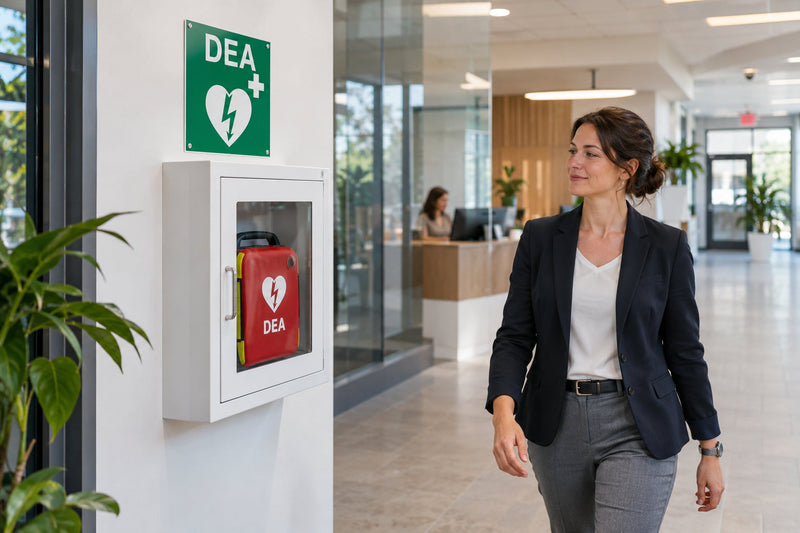
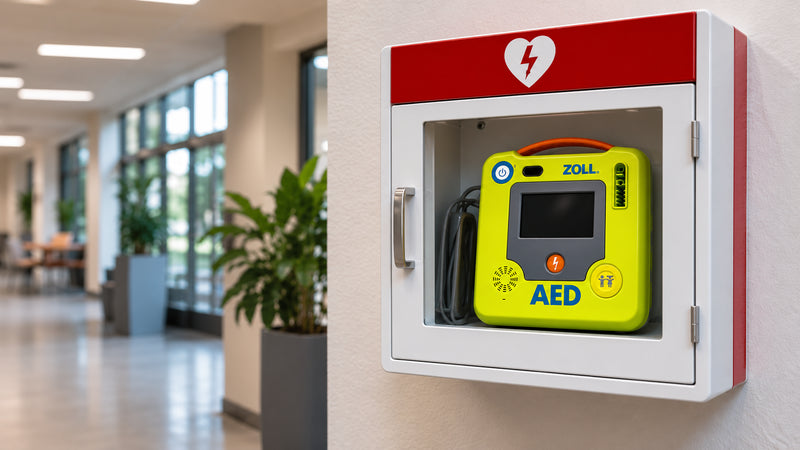
A colleague collapses at work. They are unresponsive and not breathing normally. Someone calls 911 while another person brings the defibrillator installed in the hallway.
You open the case. Now what?
Even though defibrillators are designed for use by the general public, it is completely normal to hesitate if you have never had to use one.
The first thing to know is that you do not need to determine yourself whether the person should receive an electric shock. The defibrillator analyzes their heart rhythm and makes that decision.
Your role is to follow its instructions, make sure no one touches the victim during analysis and the shock, and continue cardiopulmonary resuscitation (CPR).
Here is how an intervention works.
Before using the defibrillator: recognize cardiac arrest
An automated external defibrillator, or AED, is intended for people in cardiac arrest.
The most important signs to recognize are loss of consciousness, lack of response, and absent or abnormal breathing.
A person in cardiac arrest may sometimes appear to take large, spaced-out breaths or make gasping movements. This phenomenon, called agonal breathing, is not normal breathing.
If the person is unresponsive and not breathing normally, you must act immediately.
Call 911, start CPR, and ask someone to get an AED.
If you are alone, put your phone on speakerphone so the dispatcher can guide you. Do not wait for the defibrillator to arrive before starting chest compressions.
This is also the sequence recommended by the Heart and Stroke Foundation of Canada.
How to use a defibrillator in 5 steps
Instructions may vary slightly depending on the models, but the general operation remains similar.
1. Turn on the defibrillator
As soon as the AED arrives, place it next to the person.
Some models turn on automatically when their cover is opened. Others have a power button.
Once activated, the device begins to give voice instructions.
Listen to them and follow them in order. You do not need to memorize the entire procedure beforehand: the defibrillator guides you during the intervention.
If another person is present, they can continue chest compressions while you prepare the device.
2. Place the electrodes on the chest
The defibrillator includes adhesive electrodes that must be applied directly to the skin[JA1] . If the person has hair, it must be shaved to ensure the electrodes adhere properly.
Expose the victim's chest by removing or cutting away clothing if necessary.
The electrodes have illustrations indicating where to place them. For an adult, one is generally positioned on the upper right side of the chest and the other on the left side, under the armpit.
Always follow the illustrations provided with your device.
If the chest is wet, quickly wipe the areas where the electrodes need to be applied to help them adhere.
Make sure they are properly attached to the skin. If your model requires you to plug their connector into the AED, do so according to the instructions.
3. Let the device analyze the heart rhythm
When the electrodes are in place, the defibrillator analyzes the person's heart rhythm.
At this stage, it will ask you not to touch the victim.
It is important that no one performs chest compressions or touches the person during analysis, so as not to disrupt the reading.
The AED then determines whether an electric shock is recommended.
You do not need to interpret anything. The device itself tells you what to do next.
4. Deliver the shock if the AED recommends it
If the defibrillator detects a heart rhythm that can be treated with a shock, it will alert you.
This is where the difference between the two types of AEDs comes in.
With a semi-automatic model, you must press the shock button when the device asks you to.
With a fully automatic model, the defibrillator delivers the shock itself after giving the necessary warnings.
In both cases, make sure no one touches the victim at the time of the shock.
If the AED indicates that no shock is necessary, this does not necessarily mean that the person is okay or that their heart is functioning normally[JA2] .
You must continue resuscitation efforts according to the instructions of the device and the 911 dispatcher.
To better understand the distinction between the two technologies, view the features of the automatic and semi-automatic models in our business defibrillator selection guide.
5. Immediately resume CPR
After the shock, the defibrillator will generally ask you to resume chest compressions.
Even if a shock has just been delivered, do not wait to see if the person wakes up.
Continue CPR according to the instructions of the AED and 911.
For an adult, compressions are performed in the center of the chest, at a rate of 100 to 120 per minute, allowing the chest to return to its normal position between each compression. The dispatcher can guide you in performing the appropriate actions.
The AED will continue to guide you. It may, for example, ask you to briefly stop compressions to perform a new heart rhythm analysis.
Continue until emergency services take over or the person shows signs of life, following the directions of 911.
These steps correspond to the recommendations of Heart and Stroke on the use of an AED and the American Heart Association.
Can you use a defibrillator without training?
Yes. Defibrillators accessible to the public are designed to guide users, even when they have never taken medical training.
They provide voice instructions and, depending on the models, visual cues.
The AED analyzes the heart rhythm itself and only recommends a shock when indicated.
It is therefore not necessary to know how to read an electrocardiogram or have medical knowledge to use the device.
That said, taking a course in CPR and AED use remains an excellent idea.
It is one thing to read the instructions on a device. It is another to have already practiced chest compressions and the coordination of an intervention on a mannequin.
This familiarity can help you react more quickly when a real emergency occurs.
Can you use an AED on a wet person?
Yes, but certain precautions are necessary.
If the person is in the water, you must first move them to a safe place, out of the water, before using the AED.
If their chest is wet, wipe the areas where the electrodes will be placed. They must adhere properly to the skin.
Also make sure the environment is safe for the people intervening.
Everything does not need to be perfectly dry to begin care, but the manufacturer's instructions and safety precautions must be followed.
What if the person has a pacemaker?
The presence of a pacemaker, also called a pacemaker, does not necessarily prevent the use of an AED.
However, you must avoid placing an electrode directly on an implanted device.
It can sometimes be visible under the skin, generally in the upper part of the chest.
If you notice a lump corresponding to an implanted device, place the electrode slightly away from it, in accordance with the applicable recommendations and the instructions of the AED.
The main thing is not to unnecessarily delay defibrillation.
Can you use a defibrillator on a child?
Yes. AEDs can also be used on children, but the procedures vary depending on their age and the available device.
Some models have a pediatric mode. Others require special electrodes to reduce the energy delivered.
If you are intervening with a child, use the appropriate pediatric accessories and settings when available, following the instructions of the AED and 911.
Pediatric resuscitation recommendations also differ from those intended for adults. Appropriate training helps you prepare better.
For a school, daycare, or sports center, it is therefore important to check the device's pediatric features upon purchase.
Three things not to forget during an intervention
When you find yourself facing a person in cardiac arrest, stress can make things more difficult.
But three principles help you stay on track.
Do not delay chest compressions while waiting for the defibrillator. CPR must start quickly.
Do not touch the victim when the AED is analyzing their rhythm or delivering a shock. Follow the device's warnings.
Do not remove the electrodes after a shock. Leave the AED in place and continue following the instructions. It may need to perform a new analysis.
These are simple, but essential, actions.
Knowing how to use an AED also means knowing where to find it
A defibrillator can be very easy to use, but you still need to be able to get it quickly.
In a business, school, or sports center, everyone should know where the device is located and how to access it.
An AED stored in a locked room or whose location is unknown can delay the intervention.
This is also one of the points covered in our article Cardiac arrest can happen anywhere. Is your organization ready?.
And once the device is installed, you must make sure it remains ready to function. Electrodes expire, batteries must be replaced, and status indicators must be checked.
We explain these checks in our article AED maintenance and inspection: is your defibrillator ready to intervene?.
What to remember
No one wants to have to use a defibrillator. But knowing what to expect can make the intervention less intimidating.
You do not need to decide whether the person should receive a shock: the device takes care of it.
Your role is mainly to recognize the emergency, call 911, start CPR, and follow the instructions of the AED as soon as it is available.
At Cardio Choc, we believe that preparation is not limited to owning a defibrillator. It also involves knowing emergency procedures and having access to a functional device.
Would you like to equip your organization? Discover the defibrillators offered by Cardio Choc and choose a device suited to your environment.jean